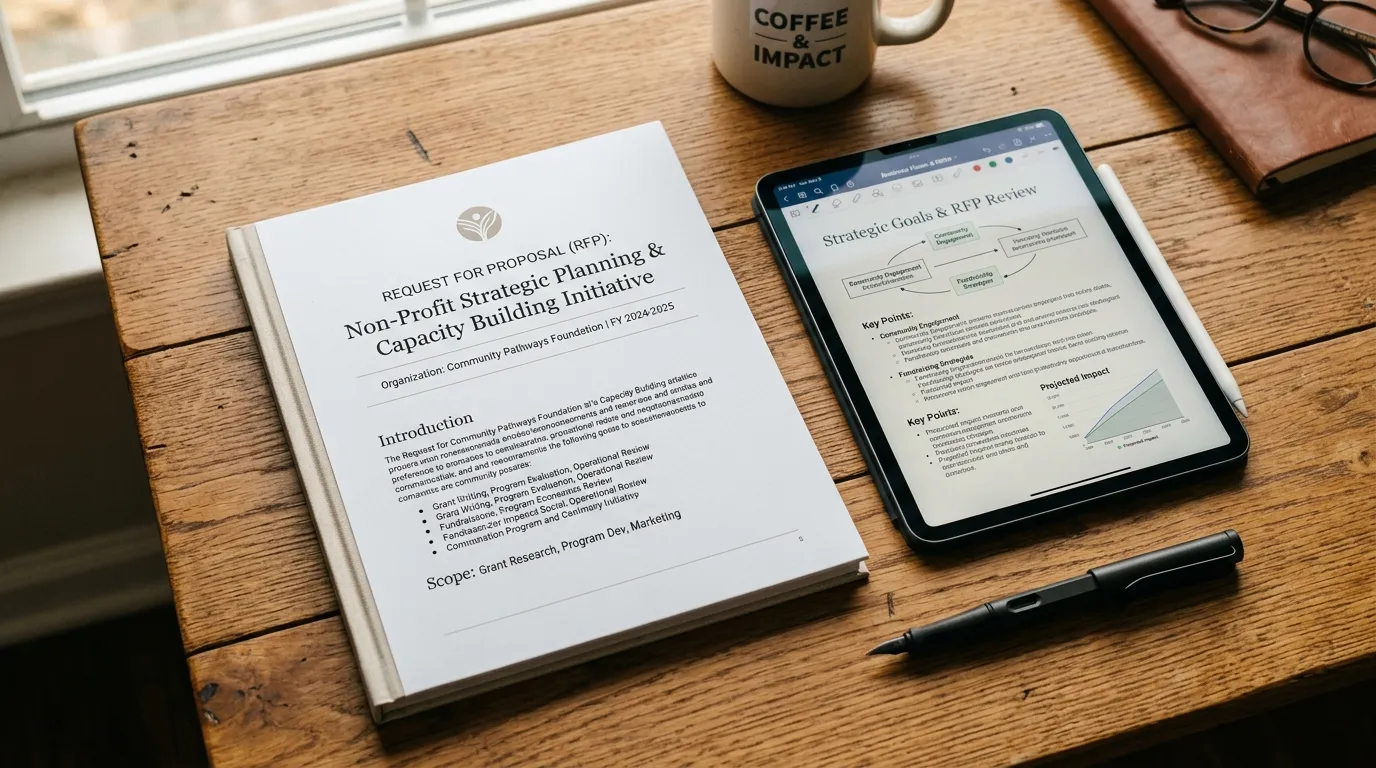
Every year, hundreds of nonprofit organizations issue Requests for Proposals (RFPs) for website redesigns. And every year, the most capable, experienced nonprofit developers quietly pass on 80% of them.
The problem isn't that developers don't care about your cause. The problem is that most nonprofit RFPs are structured in ways that inadvertently screen out skilled practitioners while attracting high-volume agency mills that bid low and charge triple later in change orders.
"A good RFP is not a laundry list of technical demands. It is an honest statement of where your organization is stuck, who you are trying to serve, and the resources you have committed to solving the problem."
Why Most Nonprofit RFPs Fail
1. Hiding the Budget Range
Nonprofits often withhold budget figures believing it gives them negotiating leverage. In reality, withholding your budget guarantees mismatched proposals. A $10,000 project requires a completely different architectural strategy than a $45,000 project. Being transparent about your budget range ($15k–$25k) saves weeks of wasted committee meetings.
2. Asking for Free Speculative Design Upfront
If your RFP asks developers to submit custom mockups, homepage concepts, or detailed wireframes as part of the initial proposal, top-tier developers will walk away. Strategic design cannot happen without deep discovery into your analytics, user personas, and donor workflows.
3. Prescribing Technical Solutions Rather Than Problems
Instead of saying "We need an SQL database with custom PHP scripts," explain the constituent problem: "Our volunteers cannot easily find regional shift openings without calling our office." Let the technical specialist propose the most elegant, cost-effective solution.
The Essential Sections of a Winning Nonprofit RFP
- Organizational Context & Mission: What do you do, who do you serve, and what is your current growth trajectory?
- The Core Problem Statement: Why is the current website failing? (e.g., high bounce rates on donation forms, confusing program navigation, poor mobile performance).
- Target Audience Personas: Primary beneficiaries, prospective individual donors, institutional grantmakers, volunteers, and media.
- Technical Ecosystem & Integrations: List your existing CRM (Salesforce NPSP, Bloomerang, DonorPerfect), email marketing platform (Mailchimp, ActiveCampaign), and payment gateways.
- Accessibility & Standards: Explicitly require WCAG 2.2 Level AA compliance.
- Budget Range & Timeline: Realistic budget boundaries and critical deadlines (such as a gala launch or grant reporting milestone).
- Submission Guidelines & Evaluation Criteria: How proposals will be scored and the date when questions will be answered.
A Better Alternative: The Discovery-First Partnership
For many small-to-midsize nonprofits, a formal 20-page RFP is unnecessary overhead. An introductory Mission Fit Discovery Call followed by a phased technical proposal often yields faster turnaround, lower overhead, and far better alignment.
Planning a website project for your organization?
Send your draft RFP or schedule a direct Mission Fit Call to discuss scope, feasibility, and budget.
Submit Your RFP / Inquire